


R-134a Refrigerant: Complete Guide for HVAC and Automotive Use

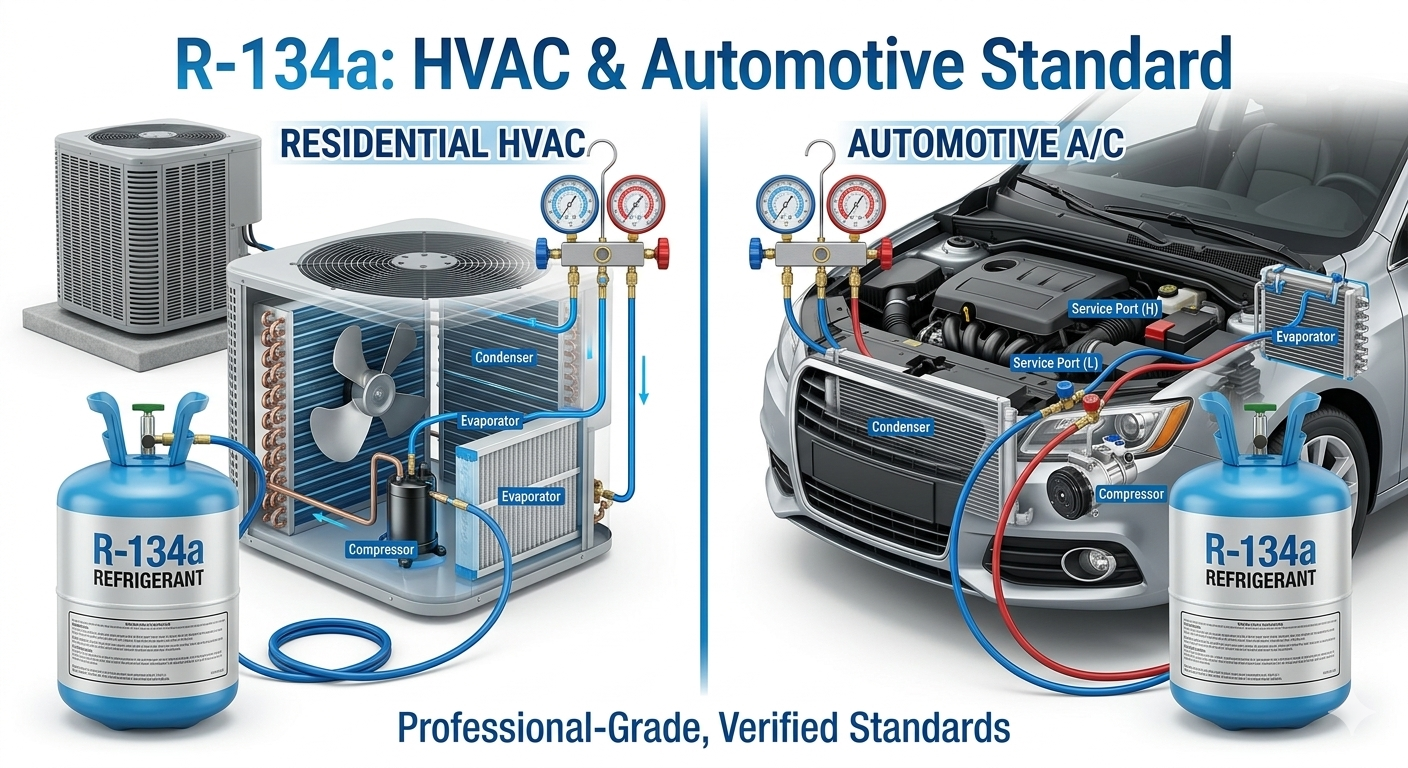
R-134a refrigerant guide: Learn applications, environmental impact, pressure requirements, safety handling, costs, and why it’s being phased out. Complete HVAC and automotive resource from igvagas.
Introduction
R-134a (HFC-134a) has been the workhorse refrigerant of the HVAC and automotive industries for over three decades. From residential air conditioning systems to vehicle AC units, R-134a has powered cooling systems in millions of installations worldwide.
But the refrigerant landscape is changing. Environmental regulations are shifting the industry toward lower-GWP alternatives like R-410A for HVAC and R-1234yf for automotive applications. Understanding R-134a—its applications, performance characteristics, environmental impact, and future—is essential for HVAC professionals, automotive technicians, and facility managers.
This comprehensive guide from igvagas covers everything you need to know about R-134a refrigerant.
What Is R-134a? The Basics
Chemical Classification
R-134a is classified as an HFC (Hydrofluorocarbon) refrigerant. Its chemical name is 1,1,1,2-tetrafluoroethane (CF₃CH₂F).
Key characteristics:
•Non-flammable: Rated A1 for safety (no ignition risk)
•Non-toxic: Safe for human exposure at normal concentrations
•Colorless: Clear, odorless liquid
•Stable: Chemically stable under normal conditions
•Miscible: Mixes well with compressor oils
Historical Context
Timeline of R-134a adoption:
•1992: EPA phased out R-12 (CFC) due to ozone depletion
•1994: R-134a became the standard replacement for R-12
•1995–2000: Widespread adoption in automotive and HVAC
•2000–2020: Dominant refrigerant globally
•2015–2021: Gradual replacement with R-410A (HVAC) and R-1234yf (automotive)
•2026+: Continued phase-down toward lower-GWP alternatives
Why R-134a Was Chosen
When R-12 was phased out, R-134a was selected because:
1.Zero ozone depletion: Contains no chlorine (ODP = 0)
2.Good cooling performance: Efficient heat transfer
3.Safety: Non-flammable, non-toxic
4.Compatibility: Works with existing system designs
5.Cost-effective: Economical to produce and distribute
6.Availability: Could be manufactured at scale
R-134a Applications: Where It’s Used
HVAC Systems (Residential and Commercial)
Residential air conditioning:
•Window AC units
•Central air conditioning systems
•Heat pumps
•Mini-split systems (some models)
Commercial refrigeration:
•Medium-temperature refrigeration
•Walk-in coolers
•Display cases
•Ice machines
Industrial applications:
•Process cooling
•Data center cooling
•Laboratory equipment
•Specialized cooling systems
Automotive Air Conditioning
Light-duty vehicles:
•Cars (pre-2015 models)
•Trucks (pre-2015 models)
•SUVs (pre-2015 models)
•Vans (pre-2015 models)
Heavy-duty vehicles:
•Some commercial trucks
•Buses
•Older fleet vehicles
Note: Most vehicles manufactured after 2015 use R-1234yf instead of R-134a.
Other Applications
•Marine AC systems: Boat and yacht cooling
•Aircraft: Some older aircraft systems
•Mobile equipment: Construction and agricultural equipment
•Specialty cooling: Medical and laboratory equipment
R-134a vs. R-12: The Phase-Out Story
Why R-12 Was Phased Out
R-12 (CFC-12, commonly called Freon) was the original refrigerant used in AC systems for decades. However, it had a critical flaw: it contains chlorine, which destroys the ozone layer.
The problem:
•When R-12 is released into the atmosphere, UV radiation breaks it down
•This releases chlorine atoms
•Chlorine catalyzes the destruction of ozone molecules
•One chlorine atom can destroy 100,000+ ozone molecules
•The result: ozone layer depletion and increased UV radiation reaching Earth
The Montreal Protocol (1987):
•International agreement to phase out ozone-depleting substances
•R-12 was identified as a major culprit
•Phase-out began in 1992 in developed countries
R-134a as the Replacement
R-134a was chosen as the replacement because:
| Property | R-12 | R-134a |
| Ozone Depletion Potential (ODP) | 1.0 (highly damaging) | 0 (none) |
| Cooling Performance | Good | Good |
| Flammability | Non-flammable | Non-flammable |
| Toxicity | Low | Low |
| System Compatibility | Mineral oil | Ester/PAG oil |
Result: R-134a successfully replaced R-12 and eliminated the ozone depletion problem.
Environmental Impact: The GWP Problem
While R-134a solved the ozone depletion problem, it introduced a new environmental concern: Global Warming Potential (GWP).
What Is GWP?
Global Warming Potential measures how much a substance contributes to climate change compared to CO2 over a 100-year period.
•CO2: GWP = 1 (baseline)
•R-134a: GWP = 1,430 (1,430 times worse than CO2)
•R-410A: GWP = 2,088 (even higher)
•R-1234yf: GWP = 4 (ultra-low)
The Climate Impact
One pound of R-134a released into the atmosphere has the same warming effect as 1,430 pounds of CO2.
When you consider:
•Millions of vehicles with R-134a AC systems
•Routine service and leaks
•End-of-life vehicle disposal
•Commercial refrigeration systems
•Industrial cooling applications
The cumulative climate impact is significant.
Regulatory Response
Kigali Amendment (2016):
•Extended the Montreal Protocol
•Mandated phase-down of high-GWP refrigerants
•Targets R-134a and R-410A for reduction
•Promotes low-GWP alternatives (R-1234yf, R-32, R-454B)
US EPA Actions:
•Phasing down R-134a production
•Promoting R-1234yf for automotive
•Supporting R-410A alternatives for HVAC
•Implementing AIM Act restrictions
Timeline:
•2020–2025: Gradual reduction in R-134a availability
•2025–2030: Further restrictions and price increases
•2030+: Continued phase-down toward elimination
R-134a Specifications and Properties
Physical Properties
| Property | Value |
| Chemical Name | 1,1,1,2-Tetrafluoroethane |
| Molecular Weight | 102.03 g/mol |
| Boiling Point | -15.3°C (4.5°F) |
| Critical Temperature | 101.06°C (214°F) |
| Critical Pressure | 40.74 bar (591 psi) |
| Density (liquid @ 25°C) | 1.207 g/cm³ |
| Vapor Pressure (@ 25°C) | 5.77 bar (84 psi) |
Performance Characteristics
Cooling Capacity:
•Moderate cooling capacity
•Suitable for moderate-temperature applications
•Less efficient than R-410A or R-1234yf
Operating Pressure:
•Lower pressure than R-410A
•Typical operating range: 50–150 psi
•Requires less robust system components
Compressor Oil Compatibility:
•Ester oils (POE)
•Polyalkylene glycol (PAG) oils
•Mineral oils (older systems)
R-134a in HVAC Systems
System Design and Components
R-134a HVAC systems typically include:
1.Compressor: Pumps refrigerant through the system
2.Condenser: Releases heat to outdoor air
3.Expansion device: Reduces pressure and temperature
4.Evaporator: Absorbs heat from indoor air
5.Refrigerant lines: Copper tubing connecting components
6.Filter-drier: Removes moisture and contaminants
7.Receiver: Stores liquid refrigerant
Charging and Service
Typical system charges:
•Residential AC: 2–5 lbs
•Commercial systems: 5–50+ lbs
•Varies by system size and design
Service requirements:
•Annual maintenance recommended
•Leak detection and repair
•Filter-drier replacement
•Oil level checks
•Pressure and temperature monitoring
Efficiency Ratings
SEER (Seasonal Energy Efficiency Ratio):
•Older R-134a systems: SEER 10–13
•Modern R-134a systems: SEER 14–16
•R-410A systems: SEER 15–21
•High-efficiency systems: SEER 20+
Note: R-410A systems are inherently more efficient due to higher pressure and better heat transfer properties.
R-134a in Automotive AC Systems
Automotive AC System Overview
Components:
•Compressor (engine-driven or electric)
•Condenser (front of vehicle)
•Evaporator (inside cabin)
•Expansion valve or orifice tube
•Receiver-drier or accumulator
•Hoses and fittings
Typical Charge Amounts
•Compact cars: 14–18 oz
•Mid-size sedans: 18–24 oz
•SUVs and trucks: 24–32 oz
•Varies by model: Always check underhood label
Service and Recharge
DIY recharge:
•Possible with 12oz cans and proper fittings
•Requires EPA 608 certification
•½” ACME thread-on fittings (standard)
•Low-side service port (larger diameter)
Professional service:
•Recovery/recharge machine required
•Leak detection and repair
•System evacuation
•Proper oil management
Transition to R-1234yf
Timeline:
•2015–2017: Most manufacturers switched to R-1234yf
•2018+: R-1234yf is standard
•Pre-2015 vehicles: Still use R-134a
•Cannot retrofit R-134a systems to R-1234yf
Pressure and System Compatibility
Operating Pressures
R-134a typical operating pressures:
| Condition | Low-Side Pressure | High-Side Pressure |
| Idle, AC off | 0 psi | 0 psi |
| Idle, AC on | 25–35 psi | 150–250 psi |
| Driving, AC on | 40–60 psi | 200–300 psi |
| Hot day, AC on | 50–70 psi | 250–350 psi |
Note: Pressures vary by ambient temperature, system design, and refrigerant charge level.
System Compatibility
R-134a systems are NOT compatible with:
•R-410A: Much higher pressure (rupture risk)
•R-1234yf: Different fittings and oil requirements
•R-22: Different pressure and oil type
•R-407C: Different pressure and performance
Attempting to mix refrigerants can result in:
•System damage
•Compressor failure
•Refrigerant leaks
•Safety hazards
•Voided warranties
Always verify the correct refrigerant type before servicing.
Safety Considerations
Flammability and Toxicity
R-134a Safety Rating: A1
•A: Non-toxic
•1: Non-flammable
Practical implications:
•Safe to handle in normal conditions
•No special ventilation required (though recommended)
•No ignition risk
•No toxic fumes at normal concentrations
Proper Handling Practices
1.Wear safety glasses and gloves
2.Work in ventilated area (recommended)
3.Avoid skin contact (can cause frostbite)
4.Never invert cylinders during charging
5.Keep away from heat (not required, but good practice)
6.Never vent refrigerant (federal violation)
7.Always recover old refrigerant properly
8.Use proper tools and equipment
EPA 608 Certification
Required to:
•Purchase R-134a in cylinders
•Handle refrigerant
•Perform AC service work
Certification levels:
•Type I: Small appliances (under 5 lbs)
•Type II: High-pressure systems (HVAC)
•Type III: Low-pressure systems (commercial)
•Universal: All types
Emergency Response
If refrigerant is released:
•Evacuate the area
•Ventilate thoroughly
•Move away from ignition sources
•Do not re-enter until area is safe
If skin contact occurs:
•Flush with water for 15 minutes
•Seek medical attention if blistering occurs
•Do not apply ice directly
Cost and Availability
Current Pricing (2026)
R-134a costs:
•Single 12oz can: $8–$15
•30lb cylinder: $80–$150
•Per-ounce cost: $0.50–$1.00
Factors affecting price:
•Market demand
•Supplier location
•Order quantity
•Seasonal variations
•Regulatory changes
Availability Trends
Current status:
•Widely available from multiple suppliers
•Supply is stable but declining
•Prices remain relatively affordable
Future outlook:
•Gradual reduction in production
•Increasing prices as phase-down continues
•Eventual phase-out (timeline uncertain)
•Estimated availability: 10–15 more years
Why Prices Are Stable Now
•Production is still permitted
•Existing inventory is substantial
•Demand is declining (shift to R-410A and R-1234yf)
•Multiple manufacturers supply the market
Comparing R-134a to Modern Alternatives
R-134a vs. R-410A (HVAC)
| Factor | R-134a | R-410A |
| GWP | 1,430 | 2,088 |
| Ozone Depletion | None | None |
| Operating Pressure | Lower | Higher (60–70% more) |
| Efficiency | Good | Better |
| System Retrofit | N/A | Not compatible |
| Availability | Declining | Increasing |
| Cost | Lower | Slightly higher |
| Future | Phase-out | Current standard |
R-134a vs. R-1234yf (Automotive)
| Factor | R-134a | R-1234yf |
| GWP | 1,430 | 4 |
| Ozone Depletion | None | None |
| Flammability | Non-flammable (A1) | Mildly flammable (A2L) |
| Service Fittings | ½” ACME | SAE J2842 quick-connect |
| Vehicles | Pre-2015 | 2015+ |
| Retrofit Possible | N/A | No |
| Environmental Impact | High | Ultra-low |
| Future | Phase-out | Current standard |
R-134a vs. R-32 (Low-GWP Alternative)
| Factor | R-134a | R-32 |
| GWP | 1,430 | 675 |
| Efficiency | Good | Excellent |
| Flammability | Non-flammable | Mildly flammable |
| Pressure | Lower | Higher |
| Retrofit Possible | N/A | Limited |
| Availability | Widespread | Growing |
| Cost | Lower | Higher |
| Future | Phase-out | Growing adoption |
Buying R-134a: What to Know
Where to Buy
igvagas provides:
•✅ Individual 12oz cans for DIY
•✅ 30lb cylinders for professional shops
•✅ Multiple brands and formats
•✅ Factory-sealed for purity
•✅ Ships from US warehouses
•✅ Fast delivery
•✅ Expert technical support
Quality Assurance
When buying R-134a, verify:
1.Purity: Should be 99.9%+ pure
2.Seal: Factory-sealed cylinders only
3.Manufacturer: Reputable brands (Honeywell, Chemours, etc.)
4.Documentation: Purity certification included
5.Supplier: Certified, reputable distributor
Seasonal Considerations
Peak demand periods:
•Spring (March–May): AC season begins
•Summer (June–August): Peak cooling demand
•Availability may tighten
•Prices may increase
Best practice: Stock up before peak season.
Bulk Purchasing
For professional shops:
•30lb cylinders offer best value
•Significant savings per ounce vs. individual cans
•Works with professional recovery equipment
•Requires EPA 608 certification
DIY AC Recharge with R-134a
What You’ll Need
1.R-134a refrigerant cans (12oz with gauge)
2.Hose and fitting kit (½” ACME for automotive)
3.Safety glasses and gloves
4.AC thermometer (optional but helpful)
5.Clean cloth for cleanup
Step-by-Step Process
Step 1: Prepare Your Vehicle
•Park in shaded, ventilated area
•Start engine
•Set AC to MAX COLD
•Set fan to highest speed
•Let run for 2–3 minutes
Step 2: Locate Service Ports
•Open hood
•Find AC service ports (usually on driver’s side)
•Low-pressure port: larger diameter, usually marked “L”
•Remove cap
Step 3: Connect Refrigerant Can
•Attach hose to low-pressure port
•Ensure secure connection
•Do not force
Step 4: Add Refrigerant
•Hold can upright
•Squeeze trigger slowly (5–10 second bursts)
•Pause between bursts
•Monitor gauge pressure
Step 5: Monitor Progress
•Watch integrated gauge
•Feel AC output temperature
•Target: 35–45°F at vents
•Typical pressure: 40–60 psi low-side
Step 6: Stop When Full
•Do not overcharge
•Disconnect can
•Replace service port cap
Step 7: Test
•Drive for 10–15 minutes
•AC should maintain cold output
When to See a Professional
Stop and see a professional if:
•System is completely empty
•You suspect a major leak
•AC doesn’t improve after recharge
•Unusual noises from compressor
•Refrigerant leaks during connection
•You’re uncomfortable with the process
Regulations and Compliance
EPA 608 Certification
Required to:
•Purchase R-134a in cylinders
•Handle refrigerant
•Perform AC service
Certification levels:
•Type I: Small appliances
•Type II: High-pressure (HVAC)
•Type III: Low-pressure (commercial)
•Universal: All types
Venting Restrictions
Federal law prohibits:
•Venting any refrigerant into the atmosphere
•Penalties: Up to $37,500 per violation
•Criminal prosecution possible
Required practice:
•Always recover refrigerant
•Use recovery equipment
•Proper disposal
Documentation
Keep records of:
•All refrigerant purchases
•Service work performed
•Refrigerant recovery amounts
•Certification status
Future of R-134a
Current Status (2026)
•Still widely available
•Supply is stable but declining
•Prices remain reasonable
•Estimated 10–15 years of availability
Phase-Out Timeline
Estimated schedule:
•2026–2030: Gradual reduction in production
•2030–2035: Significant phase-down
•2035–2040: Limited availability
•2040+: Likely phase-out complete
Note: Timeline depends on regulatory decisions and market conditions.
Replacement Refrigerants
HVAC systems:
•R-410A (current standard)
•R-32 (low-GWP alternative)
•R-454B (drop-in R-410A replacement)
Automotive systems:
•R-1234yf (current standard)
•R-1234ze (potential future)
Commercial refrigeration:
•R-448A (R-404A replacement)
•R-449A (R-404A replacement)
•Natural refrigerants (CO2, hydrocarbons)
Bottom Line: R-134a Refrigerant
Key Takeaways
1.R-134a is still widely used but being phased out
2.Environmental impact is significant (GWP = 1,430)
3.Regulatory phase-down is underway
4.Replacement refrigerants are now standard
5.Availability will decline over next 10–15 years
6.Prices may increase as supply reduces
7.Proper handling is essential for compliance
8.EPA 608 certification is required
When to Use R-134a
Use R-134a if:
•Servicing pre-2015 vehicles (automotive)
•Maintaining older HVAC systems
•Existing R-134a systems need recharge
•Cost is a primary concern
•Certified to handle and purchase
Consider alternatives if:
•Installing new systems (use R-410A or R-1234yf)
•Concerned about environmental impact
•Want long-term refrigerant availability
•Planning for future compliance
Need R-134a Refrigerant?
At igvagas, we supply R-134a for HVAC and automotive applications:
•✅ Individual 12oz cans for DIY recharge
•✅ 30lb cylinders for professional shops
•✅ Factory-sealed for certified purity
•✅ Multiple brands available
•✅ Ships from US warehouses
•✅ Fast delivery
•✅ Expert technical support
Shop R-134a Cans | Shop 30lb Cylinders | Get Bulk Pricing
Frequently Asked Questions
Is R-134a being phased out?
Yes, gradually. R-134a production is being reduced under the Kigali Amendment. However, it will remain available for 10–15+ more years for servicing existing systems.
Can I use R-134a in an R-410A system?
No. R-410A operates at much higher pressures. Using R-134a would cause system failure and safety hazards.
Is R-134a safe to handle?
Yes. R-134a is non-flammable and non-toxic (A1 rating). With proper handling and ventilation, it’s safe.
How much does R-134a cost?
Individual 12oz cans: $8–$15. 30lb cylinders: $80–$150. Prices vary by supplier and market conditions.
Do I need EPA certification to buy R-134a?
Yes. EPA 608 Type II or Universal certification is required to purchase and handle R-134a.
Can I recharge my car’s AC myself?
Yes, if the system just needs a small charge. Use 12oz cans with integrated gauges. For major leaks or empty systems, see a professional.
What’s the difference between R-134a and R-1234yf?
R-1234yf has ultra-low GWP (4 vs. 1,430) and is the standard for new vehicles. R-134a is used in older vehicles. They’re not interchangeable.
How long will R-134a remain available?
Estimated 10–15 more years for servicing existing systems. Production is being gradually reduced.
What should I do with old R-134a?
Never vent it. Always recover and recycle through a certified facility. Many shops offer free or low-cost recovery.
What’s the best alternative to R-134a?
For HVAC: R-410A (current standard) or R-32 (low-GWP). For automotive: R-1234yf (current standard).
Related Articles
•R-410A vs R-22 Refrigerant: Complete Comparison Guide for HVAC Technicians
•R-1234yf Refrigerant: The Complete Guide for Automotive AC Systems
•Low-GWP Refrigerants: The Future of HVAC and Automotive Cooling
•EPA 608 Certification: What HVAC and Automotive Technicians Need to Know
Author: igvagas Technical Team | HVAC and Automotive Refrigerant Specialists