


R-1234yf Refrigerant: The Complete Guide for Automotive AC Systems

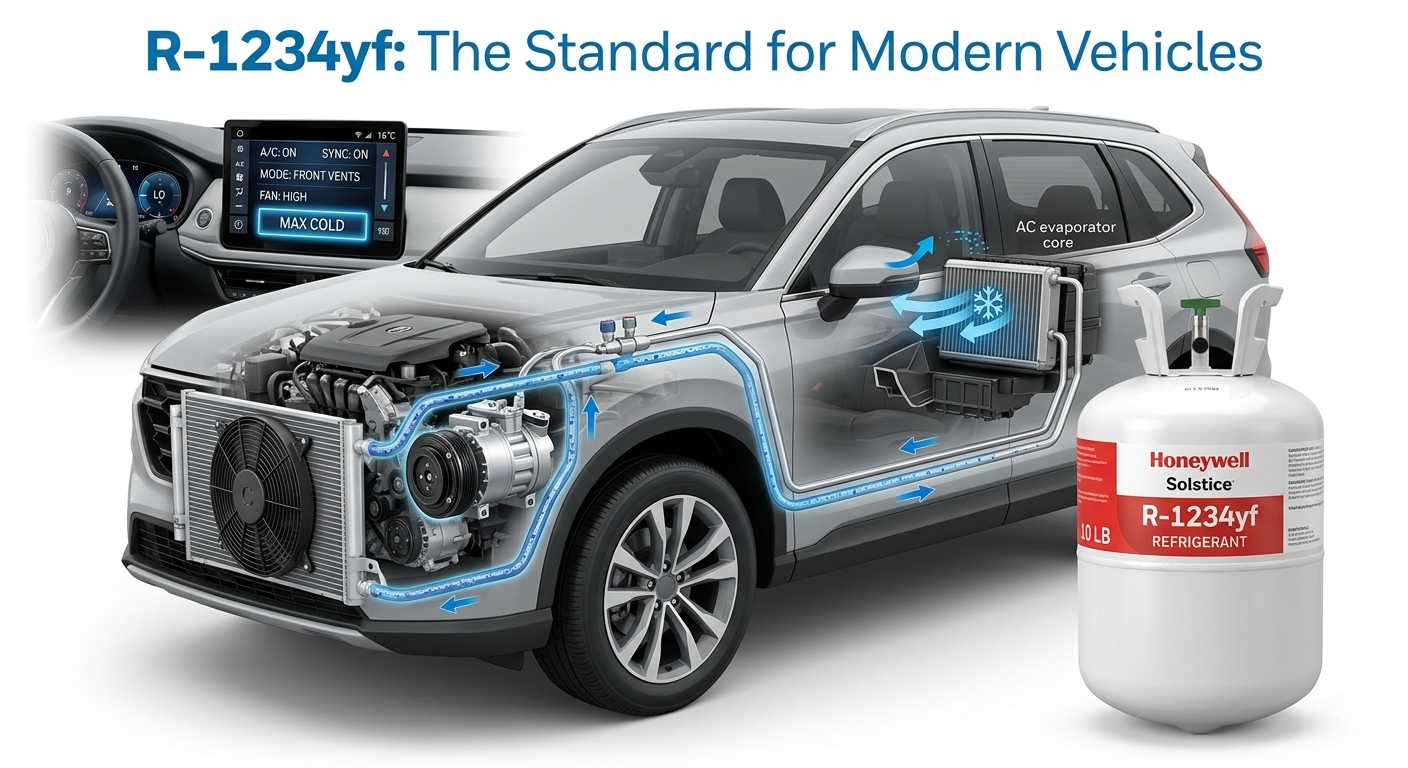
R-1234yf is now the standard refrigerant for new vehicles. Learn how to identify it, recharge your car’s AC, handle A2L flammability safely, and buy from igvagas. Complete automotive AC guide.
Introduction
R-1234yf (HFO-1234yf) is now the standard refrigerant in virtually every new vehicle sold in the US and Europe. If you work on cars built after 2014–2017, you’re increasingly encountering this refrigerant. By 2026, the vast majority of vehicles on the road being serviced will use R-1234yf.
But what exactly is R-1234yf? How is it different from the older R-134a? And what do you need to know about handling, recharging, and buying it?
This comprehensive guide from igvagas covers everything automotive technicians and DIYers need to know about R-1234yf refrigerant.
Why R-1234yf Replaced R-134a
The answer is environmental protection and climate responsibility.
The Global Warming Problem with R-134a
R-134a has been the automotive AC standard since 1992. However, it has a significant environmental drawback: a Global Warming Potential (GWP) of 1,430. This means one pound of R-134a released into the atmosphere has 1,430 times the warming effect of CO2 over 100 years.
When you consider:
•Millions of vehicles on the road
•Routine AC service and leaks
•Accidental releases during maintenance
•End-of-life vehicle disposal
The cumulative climate impact of R-134a is substantial.
The R-1234yf Solution
R-1234yf was developed as a low-GWP alternative with a GWP of just 4. This represents a 99.7% reduction in global warming potential compared to R-134a.
This dramatic environmental improvement is why:
•US EPA mandated R-1234yf for all new light-duty vehicles starting in 2021
•European MAC Directive required the switch for all new vehicles sold in Europe
•Automakers (Toyota, Honda, Ford, BMW, Mercedes, etc.) transitioned their entire fleets
•Technicians must now understand and work with R-1234yf
Quick Comparison: R-1234yf vs R-134a
| Property | R-134a | R-1234yf |
| GWP (100-year) | 1,430 | 4 |
| Ozone Depletion Potential | None | None |
| Boiling Point | -15.3°F | -17.4°F |
| Flammability Rating | Non-flammable (A1) | Mildly flammable (A2L) |
| Typical System Charge | 14–32 oz | 14–32 oz |
| SAE Standard | J639 | J2842 |
| Service Port Fitting | ½” ACME low-side | Unique quick-connect (SAE J2842) |
| Compressor Oil | Ester or PAG | Ester or PAG |
| EPA Certification Required | Yes | Yes |
| Availability | Declining | Rapidly increasing |
| Cost | $8–$15/oz | $12–$20/oz |
Understanding R-1234yf: What It Is
Chemical Classification
R-1234yf is classified as an HFO (Hydrofluoroolefin) refrigerant. Unlike older refrigerants:
•R-134a (HFC): Contains no chlorine but has high GWP
•R-1234yf (HFO): Contains no chlorine and has ultra-low GWP
•R-22 (HCFC): Contains chlorine (ozone-depleting)
The HFO classification means R-1234yf breaks down in the atmosphere much faster than R-134a, leaving no residual climate impact.
Performance Characteristics
Cooling Capacity:
•Slightly higher cooling capacity than R-134a
•Allows for more efficient AC systems
•Better performance in high-temperature conditions
Pressure:
•Similar operating pressures to R-134a
•Existing R-134a systems cannot be retrofitted (different oil requirements and fittings)
•New R-1234yf systems are specifically designed for this refrigerant
System Charge:
•Typical charge: 14–32 oz (same as R-134a)
•Varies by vehicle model and AC system design
•Always check the underhood label for exact specification
The A2L Flammability Rating: What You Need to Know
One aspect of R-1234yf that causes concern is its A2L flammability classification. Let’s break down what this actually means and why it’s not as scary as it sounds.
What Does A2L Mean?
Refrigerants are classified by safety:
•A1: Non-flammable, non-toxic (R-134a, R-410A)
•A2L: Mildly flammable, low toxicity (R-1234yf)
•A3: Highly flammable, low toxicity (R-290, propane)
•B1: Non-flammable, toxic
•B2: Mildly flammable, toxic
•B3: Highly flammable, toxic
The Lower Flammability Limit (LFL)
R-1234yf’s Lower Flammability Limit (LFL) is 6.2%. This means:
•The refrigerant must reach 6.2% concentration in air before it can ignite
•An ignition source (flame, spark, hot surface) must be present
•In normal automotive AC service conditions, the risk of reaching 6.2% concentration is negligible
Real-World Risk Assessment
According to:
•SAE (Society of Automotive Engineers): Risk is negligible in normal service
•ASHRAE (American Society of Heating, Refrigerating and Air-Conditioning Engineers): A2L is safe for automotive use
•Major automakers (Toyota, Honda, Ford, BMW, Mercedes): A2L is safe and widely used globally
In practice: Millions of vehicles worldwide use R-1234yf daily without incident. The A2L classification is a precaution, not a practical hazard in automotive AC service.
Safe Handling Practices
While the risk is low, proper handling practices are important:
1.Use dedicated R-1234yf equipment: Do not cross-contaminate with R-134a equipment
2.Work in ventilated areas: Ensure adequate air circulation
3.Avoid open flame: Do not expose cylinders to direct flame or extreme heat
4.No smoking: Follow standard shop safety protocols
5.Proper recovery: Always recover refrigerant properly; never vent
6.Training: Ensure technicians understand R-1234yf handling
How to Identify If Your Vehicle Uses R-1234yf
Method 1: Check the Underhood Label
The most reliable way to identify your vehicle’s refrigerant:
1.Open the hood
2.Look for a label on or near the AC compressor
3.Look near the service ports (usually on the driver’s side near the engine)
4.The label will clearly state the refrigerant type and charge amount
Example labels:
•”Refrigerant: R-1234yf, Charge: 24 oz”
•”Use only R-1234yf HFO-1234yf”
Method 2: Check the Service Port Fitting
R-1234yf uses a unique quick-connect fitting per SAE J2842 standard. This is physically different from R-134a ports:
•R-134a: ½” ACME thread-on fittings (universal across vehicles)
•R-1234yf: Proprietary quick-connect fittings (unique to R-1234yf)
Important: An R-134a hose will NOT connect to an R-1234yf port. The fittings are incompatible by design to prevent cross-contamination.
Method 3: Check Your Vehicle’s Model Year
General timeline:
•2013–2014: Some manufacturers (Fiat, Ferrari) began transitioning
•2015–2017: Most manufacturers switched to R-1234yf
•2018+: Nearly all new vehicles use R-1234yf
•2020+: R-1234yf is universal for new vehicles
Note: Timing varies by manufacturer and region. Always verify with your specific vehicle’s documentation.
Method 4: Use a VIN Decoder or Service Manual
For definitive information:
1.Use an online VIN decoder (e.g., Edmunds, Cars.com)
2.Consult the factory service manual
3.Contact your vehicle’s manufacturer
4.Ask your dealership service department
DIY AC Recharge: How to Do It Safely
If your vehicle’s AC is running warm or not cold enough, a simple recharge might be all you need. Here’s how to do it safely with R-1234yf.
What You’ll Need
1.R-1234yf refrigerant cans with integrated gauge and SAE J2842 fitting
2.AC thermometer (optional but helpful)
3.Safety glasses and gloves
4.Ventilated workspace
5.Clean cloth for cleanup
igvagas carries:
•Honeywell Solstice R-1234yf 8oz cans (single)
•R-1234yf 3-pack (24oz total)
•R-1234yf 4-pack (32oz total)
•R-1234yf 8-pack (64oz total)
Step-by-Step Recharge Process
Step 1: Prepare Your Vehicle
•Park in a shaded, ventilated area
•Start the engine
•Set AC to MAX COLD
•Set fan to highest speed
•Let the engine idle for 2–3 minutes
Step 2: Locate the Low-Pressure Service Port
•Open the hood
•Find the AC service ports (usually on driver’s side)
•The low-pressure port is the larger diameter line
•It’s usually marked with an “L” or blue cap
•Remove the cap
Step 3: Connect the Refrigerant Can
•Attach the R-1234yf can’s quick-connect fitting to the low-pressure port
•Ensure a secure connection
•Do NOT force—the fitting should click into place smoothly
Step 4: Add Refrigerant Slowly
•Hold the can upright (not inverted)
•Squeeze the trigger slowly to release refrigerant
•Add in small bursts (5–10 seconds at a time)
•Pause between bursts to allow pressure to equalize
Step 5: Monitor Pressure and Temperature
•Watch the can’s integrated gauge
•Target pressure varies by ambient temperature (typically 40–60 psi on low side)
•Feel the AC output—it should get progressively colder
•Use an AC thermometer if available (target: 35–45°F at vents)
Step 6: Stop When Full
•Do NOT overcharge—excess refrigerant damages the compressor
•When the AC feels cold and the gauge shows proper pressure, stop
•Disconnect the can by pressing the release button
•Replace the service port cap
Step 7: Test and Verify
•Drive the vehicle for 10–15 minutes
•AC should maintain cold output
•No hissing or unusual sounds
When to See a Professional
Stop and see a professional if:
•The system is completely empty (no pressure at all)
•You suspect a major leak
•The AC doesn’t improve after adding refrigerant
•You hear unusual noises from the compressor
•Refrigerant leaks during connection
•You’re uncomfortable with the process
A professional shop can:
•Perform a leak detection test
•Recover old refrigerant properly
•Repair leaks
•Use professional recovery/recharge equipment
•Verify system performance
Bulk 10lb Cylinders for Professional Shops
For high-volume shops servicing modern vehicles, keeping a 10lb Honeywell R-1234yf cylinder on hand is essential.
Advantages of Bulk Cylinders
Cost Savings:
•10lb cylinder: ~$12–$15/oz
•Individual 8oz cans: ~$15–$20/oz
•Savings: 25–40% per ounce with bulk
Professional Equipment:
•Works with manifold gauges and recovery machines
•Allows precise charging
•Better for complex AC work
Efficiency:
•No need to buy multiple cans
•Reduces waste
•Faster service times
Honeywell Solstice R-1234yf 10lb Cylinder
Specifications:
•Made in USA
•Meets all OEM specifications
•Factory-sealed for purity
•Compatible with all R-1234yf systems
•Ships from US warehouses
Best For:
•Professional AC service shops
•Fleet maintenance facilities
•High-volume technicians
•Dealership service departments
EPA Certification and Legal Requirements
Do You Need EPA 608 Certification?
Yes. To purchase and handle R-1234yf refrigerant, you must have:
•EPA 608 Type II Certification (for light-duty vehicles), OR
•EPA 608 Universal Certification (covers all refrigerant types)
Why This Requirement?
The EPA mandates certification to ensure:
•Proper refrigerant handling
•Prevention of atmospheric venting
•Correct recovery procedures
•Environmental protection
How to Get Certified
1.Study EPA 608 exam materials
2.Take the exam through an approved testing center
3.Pass with a score of 70% or higher
4.Receive certification card (valid for 5 years)
5.Renew before expiration
Penalties for Non-Compliance
Operating without proper certification can result in:
•Fines up to $37,500 per violation
•Criminal prosecution
•Loss of business license
•Liability for environmental damage
Buying R-1234yf: What to Know
Where to Buy
igvagas provides:
•✅ Honeywell Solstice R-1234yf (OEM-approved)
•✅ Individual 8oz cans for DIY
•✅ Multi-packs (3, 4, 8 packs)
•✅ Bulk 10lb cylinders for shops
•✅ Factory-sealed for purity
•✅ Ships from US warehouses
•✅ Fast delivery
•✅ Expert technical support
Quality Assurance
When buying R-1234yf, verify:
1.Manufacturer: Honeywell Solstice is OEM-approved
2.Purity: Should be 99.9%+ pure
3.Seal: Factory-sealed cylinders only
4.Documentation: Comes with purity certification
5.Supplier: Reputable, certified distributor
Pricing
Individual cans (8oz):
•Single can: $15–$25
•3-pack: $40–$60
•4-pack: $50–$75
•8-pack: $95–$140
Bulk cylinders (10lb):
•10lb cylinder: $120–$180
•Professional recovery equipment required
Factors affecting price:
•Supplier location
•Order quantity
•Shipping costs
•Market demand
•Seasonal variations
Seasonal Availability
Plan ahead for summer:
•Spring/summer demand increases
•Availability may tighten
•Prices may increase
•Delivery times may extend
Best practice: Stock up before the cooling season begins.
Comparing R-1234yf to Other Automotive Refrigerants
R-1234yf vs R-134a
| Factor | R-134a | R-1234yf |
| Environmental Impact | High GWP (1,430) | Ultra-low GWP (4) |
| Cooling Performance | Good | Slightly better |
| System Compatibility | Older vehicles | New vehicles (2015+) |
| Cost | Lower | Slightly higher |
| Availability | Declining | Increasing |
| Retrofit Possible | N/A | No |
R-1234yf vs R-1234ze
•R-1234ze: Another HFO refrigerant with ultra-low GWP
•Use: Commercial refrigeration and some industrial applications
•Automotive: Not used in cars (different pressure characteristics)
•Confusion: R-1234ze and R-1234yf are different—not interchangeable
R-1234yf vs Propane (R-290)
•R-290: Natural refrigerant with zero GWP
•Flammability: Highly flammable (A3)
•Automotive use: Not approved for automotive AC in US/Europe
•Status: Used in some aftermarket conversions (not recommended)
Safety Tips for R-1234yf Handling
For DIYers
1.Read instructions on the can carefully before use
2.Wear safety glasses and gloves
3.Work in ventilated area with good airflow
4.Keep away from flame and heat sources
5.Do not smoke while handling refrigerant
6.Never invert the can during charging
7.Stop immediately if you feel uncomfortable
8.Dispose properly of empty cans (recycling center)
For Professional Technicians
1.Use dedicated R-1234yf equipment (not cross-contaminated)
2.Maintain proper ventilation in service area
3.Follow SAE J2842 standards for service procedures
4.Use recovery equipment for proper refrigerant recovery
5.Wear appropriate PPE (safety glasses, gloves, apron)
6.Keep first aid kit accessible
7.Train staff on R-1234yf handling
8.Document all service for compliance
Emergency Response
If refrigerant is released:
•Evacuate the area
•Ventilate thoroughly
•Move away from ignition sources
•Call emergency services if needed
•Do not re-enter until area is safe
The Future of Automotive Refrigerants
Current Status (2026)
•R-1234yf is the standard for all new vehicles
•Millions of vehicles worldwide use R-1234yf daily
•Proven track record of safety and reliability
Future Developments
Potential next-generation refrigerants:
•R-1234ze: Possible future alternative (ultra-low GWP)
•R-1234yf improvements: Enhanced formulations in development
•Natural refrigerants: Research into CO2 and hydrocarbons
•Synthetic alternatives: New HFO compounds being tested
Timeline:
•2026–2030: R-1234yf remains dominant
•2030–2035: Potential introduction of next-generation low-GWP options
•2035+: Gradual transition to even lower-impact refrigerants
Bottom Line: R-1234yf for Automotive AC
Key Takeaways
1.R-1234yf is the new standard for all new vehicles (2015+)
2.Environmental benefits are substantial (99.7% lower GWP than R-134a)
3.A2L flammability is safe with proper handling
4.DIY recharge is possible with 8oz cans and proper technique
5.Professional service is recommended for major work
6.EPA 608 certification is required to purchase
7.Bulk cylinders offer best value for shops
8.Proper handling ensures safety and compliance
When to DIY vs. Professional Service
DIY with 8oz cans if:
•AC is slightly warm (small charge needed)
•You have EPA 608 certification
•You’re comfortable with the process
•System is not completely empty
See a professional if:
•System is completely empty
•You suspect a major leak
•Compressor is making noise
•You lack EPA 608 certification
•You’re uncomfortable with the procedure
Need R-1234yf for Your Vehicle?
At igvagas, we supply Honeywell Solstice R-1234yf for automotive AC systems:
•✅ Individual 8oz cans for DIY recharge
•✅ Multi-packs (3, 4, 8 packs) for convenience
•✅ Bulk 10lb cylinders for professional shops
•✅ Factory-sealed for certified purity
•✅ OEM-approved Honeywell Solstice brand
•✅ Ships from US warehouses
•✅ Fast delivery
•✅ Expert technical support
Shop R-1234yf Cans | Shop 10lb Cylinders | Get Bulk Pricing
Frequently Asked Questions
Can I use R-1234yf in an older R-134a vehicle?
No. R-1234yf systems are specifically designed for this refrigerant. Using it in an R-134a system would cause pressure and compatibility issues. Additionally, it’s illegal to retrofit without proper engineering.
Is R-1234yf safe to handle?
Yes. With proper handling and ventilation, R-1234yf is safe. The A2L flammability rating is a precaution, not a practical hazard in normal automotive AC service.
How much does R-1234yf cost?
Individual 8oz cans: $15–$25. Bulk 10lb cylinders: $120–$180. Prices vary by supplier and market conditions.
Where can I buy R-1234yf?
igvagas carries Honeywell Solstice R-1234yf in all formats: individual cans, multi-packs, and bulk cylinders. Ships from US warehouses.
Do I need EPA certification to buy R-1234yf?
Yes. EPA 608 Type II or Universal certification is required to purchase and handle R-1234yf.
Can I recharge my car’s AC myself?
Yes, if the system just needs a small charge. Use 8oz cans with integrated gauges and follow proper procedures. For major leaks or empty systems, see a professional.
What’s the difference between R-1234yf and R-1234ze?
R-1234ze is a different refrigerant used in commercial refrigeration, not automotive AC. They are not interchangeable.
How do I know if my car uses R-1234yf?
Check the underhood label near the AC compressor or service ports. It will specify the refrigerant type. Most vehicles 2015+ use R-1234yf.
Is R-1234yf more expensive than R-134a?
Slightly. R-1234yf costs 10–20% more per ounce than R-134a, but the environmental benefits justify the cost.
What should I do if I spill R-1234yf?
Evacuate the area, ventilate thoroughly, and move away from ignition sources. Do not re-enter until the area is safe. For large spills, contact emergency services.
Related Articles
•R-410A vs R-22 Refrigerant: Complete Comparison Guide for HVAC Technicians
•R-134a Refrigerant: Complete Guide for HVAC and Automotive Use
•EPA 608 Certification: What Automotive Technicians Need to Know
•Low-GWP Refrigerants: The Future of Automotive and HVAC Systems
Author: igvagas Technical Team | Automotive Refrigerant Specialists
Published: [Current Date]
Read Time: 15 minutes
Category: Automotive AC